


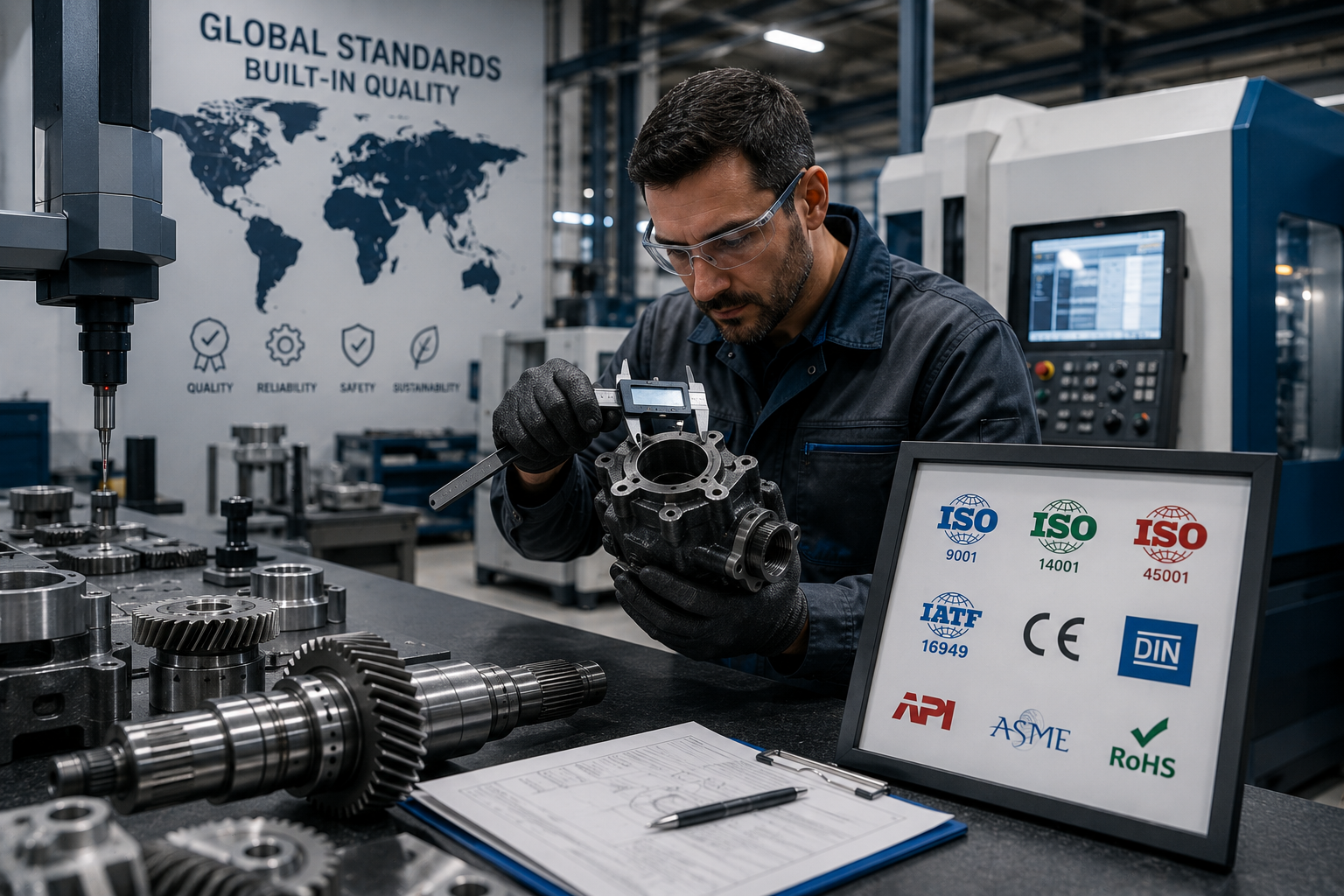

In simple terms, standards help turn manufacturing from personal habit into repeatable evidence, and this matters deeply when someone asks what is a pto?, because the answer is not only about how a PTO transfers power from a vehicle transmission or driveline to auxiliary equipment; it is also about how that PTO is selected, calculated, machined, controlled, tested, installed and supported through documentation. For a manufacturer such as Özcihan Makina, global standards create a practical framework for quality, safety, environmental responsibility and customer trust, especially when PTOs and related power transmission components must work in heavy duty conditions where downtime is expensive and field reliability matters every day.
Introduction: Why Standards Matter in PTO Manufacturing
PTO manufacturing sits at the intersection of vehicle engineering, gearbox design, hydraulic power, machinery safety and international trade, which means one single product may need to satisfy many different expectations at once. A PTO must fit the transmission interface, handle torque demand, deliver the required output speed, support the correct rotation direction, avoid premature wear, protect the operator through safe use guidance and remain traceable through production records. This is why global standards matter so much, because they do not replace engineering experience, but they organize it like a well planned workshop where every tool has its place, every measurement has a purpose and every record helps prove that the product was made with control.

The most familiar starting point is ISO 9001, the internationally recognized quality management standard that helps organizations consistently meet customer and regulatory requirements while improving their processes. In PTO production, ISO 9001 thinking can influence supplier control, machining plans, calibration records, inspection criteria, nonconformity handling, corrective actions and customer feedback, which means it supports the full journey from raw material to final shipment. When buyers compare truck pto models, they should not only ask whether a model fits their vehicle; they should also ask whether the manufacturer has a systematic quality culture behind the part.
ISO 9001: The Backbone of Repeatable PTO Quality
ISO 9001 is especially important in PTO manufacturing because repeatability is the heart of industrial trust. A prototype can perform well once, but customers need every production unit to meet defined requirements again and again, and that is where documented processes, inspection plans, calibrated measuring tools and corrective action systems become valuable. I like to compare ISO 9001 to the rhythm section of a band 🎼; it may not always be the most visible part of the performance, but without its steady structure, the whole production song loses timing. In PTO manufacturing, that rhythm appears in controlled gear machining, housing inspection, shaft tolerances, bearing selection, sealing checks, assembly discipline and final functional verification.

This quality system approach becomes even more important for split shaft pto models, because split shaft applications often involve demanding driveline based power transfer, higher auxiliary loads and more complex vehicle body requirements. If a standard transmission mounted PTO is like a strong side road from the main power highway, a split shaft system is more like a controlled junction on that highway, and the quality system behind it must ensure that the product is not only strong in theory but consistent in production and reliable in real field conditions.
| Standard or Framework | Main Focus | Why It Matters in PTO Manufacturing | Practical Customer Benefit |
|---|---|---|---|
| ISO 9001 | Quality management system | Controls repeatability, documentation, inspection and continuous improvement | More consistent products and stronger traceability |
| ISO 14001 | Environmental management system | Supports structured management of environmental responsibilities in production | Cleaner manufacturing habits and better supply chain confidence |
| ISO 45001 | Occupational health and safety management | Helps manufacturers manage workplace safety risks during production | Safer production culture and more responsible operations |
| ISO 12100 | Machinery safety and risk reduction principles | Guides hazard identification and risk reduction thinking in machinery design | Better safety awareness in product and application guidance |
| ISO 6336 | Gear load capacity calculation | Provides methods for comparing spur and helical gear designs | More disciplined gear engineering decisions |
| EU Machinery Regulation 2023/1230 | Health and safety requirements for machinery placed on the EU market | Shapes conformity expectations for machinery and related systems | Improved market readiness and compliance planning |
| REACH and RoHS | Chemicals and restricted substances | Supports material and substance responsibility when products or components enter relevant markets | Lower compliance risk and better documentation |
ISO 14001 and Environmental Responsibility
Modern PTO manufacturing cannot focus only on mechanical strength, because customers increasingly care about how industrial products are produced, what materials are used, how waste is managed and whether the manufacturer treats environmental responsibility as a real operating discipline. ISO 14001 provides a recognized framework for establishing, maintaining and improving an environmental management system, and for PTO manufacturers this can include controlled handling of oils and coolants, metal chip recycling, waste separation, chemical documentation, energy awareness and continuous improvement in factory processes. This matters because a durable PTO produced in a cleaner and better controlled environment carries a stronger trust story than a product that is only technically correct.

Environmental thinking also connects directly with hydraulic systems, because PTOs often drive hydraulic pump models, and hydraulic power transfer involves oils, seals, hoses, fittings and maintenance practices that can influence both performance and environmental impact. A well matched PTO and pump system can reduce unnecessary heat, strain and premature component replacement, and this is why sustainability should be seen not only as factory recycling but also as long lasting product design that helps customers use machinery more responsibly across the whole service life.
ISO 45001: Safety Starts Inside the Factory
A responsible PTO manufacturer must also care about the people who produce, assemble, inspect and package the components, because quality and safety grow from the same culture of attention. ISO 45001 defines requirements for occupational health and safety management systems and helps organizations manage risks while improving safety performance, which is highly relevant in machinery production environments where machining centers, lifting operations, cutting fluids, rotating parts and assembly work all require discipline. I see workplace safety as the human side of manufacturing quality, because a factory that protects its people is more likely to protect its processes too.

In PTO manufacturing, a strong safety culture can support better handling of heavy housings, safer machining procedures, cleaner assembly areas, better maintenance of production equipment and more careful final inspection behavior. Products such as gear pump models and piston pump models also benefit from this culture, because the same teams, tools and quality habits often shape the broader power transmission and hydraulic product ecosystem around PTO applications.
ISO 12100 and Machinery Safety Thinking
While ISO 9001 looks at quality management, ISO 12100 focuses on machinery safety principles, including risk assessment and risk reduction, and this kind of thinking is useful when PTO manufacturers prepare technical information, application guidance and safe use expectations. A PTO is a rotating power device, and rotating power deserves respect because incorrect engagement, poor guarding, unsuitable installation or lack of operator awareness can create serious hazards. For this reason, safety thinking must appear not only in the product but also in manuals, warning labels, installation recommendations and body builder communication.

For example, when a PTO system connects to shafts, couplings or external equipment, the design and installation team should consider moving part exposure, access points, guarding, maintenance procedures and safe operating conditions. This is where couplings models and cardan shafts models become part of the safety conversation, because power transfer components must be selected and installed with a full view of mechanical behavior, operator exposure and maintenance reality.
ISO 6336 and Gear Engineering Discipline
PTOs are often gear based products, so gear engineering standards deserve special attention. ISO 6336 provides principles and methods related to calculating the load capacity of spur and helical gears, and although no calculation standard alone guarantees the performance of an assembled gearbox in every real world situation, it gives engineers a disciplined way to compare gear designs and think about load capacity. In practical terms, this matters because PTO gears face torque, vibration, engagement forces, duty cycles and connected equipment loads that can punish weak design decisions very quickly.

The same calculation mindset also supports reducer models, because reducers and PTO gearboxes share important engineering concerns such as tooth contact, bending strength, pitting resistance, lubrication, housing stiffness and bearing support. I like to think of ISO 6336 as a measuring map rather than the whole journey, because it helps engineers navigate gear design decisions, but final product reliability still depends on material quality, heat treatment, machining precision, assembly control, testing and field feedback.
EU Machinery Regulation, CE Thinking and Market Access
Global PTO manufacturers also need to understand market access rules, especially when products are used in machinery or vehicle mounted systems entering European markets. The EU Machinery Regulation 2023/1230 sets health and safety requirements for machinery placed on the EU market and replaces the older Machinery Directive framework from January 20, 2027, so manufacturers, importers and body builders need to think carefully about conformity documentation, technical files, risk assessment and instructions. Even when a PTO is supplied as a component within a larger system, the larger machinery compliance picture can affect how the product is documented and integrated.
-212781031195243.png)
This is especially important in applications using water pumps, fire fighting bodies, municipal equipment and construction machinery, where the PTO may support critical auxiliary functions. Products such as fire fighting water pump models show how PTO based power transmission can become part of a broader machinery system, and when systems become more complex, documentation and compliance planning become even more valuable. In this environment, Özcihan Makina can be understood as part of a serious industrial supply chain where product performance, documentation and application support all need to work together.
REACH, RoHS and Material Compliance
Beyond ISO, material and chemical compliance can also become important depending on the product, component scope and target market. The European Commission describes REACH as the EU regulation addressing chemical risks to human health and the environment, while RoHS restricts hazardous substances in electrical and electronic equipment. A purely mechanical PTO may not always fall under the same rules as electronic equipment, yet modern vehicle mounted systems increasingly include sensors, switches, solenoids, wiring and electronic controls, so manufacturers and body builders should keep material declarations, supplier documentation and restricted substance awareness under control.

Material compliance is like knowing the full family history of a product before trusting it in a global supply chain, because a component may look perfect from the outside while still creating risk if documentation is missing. This is why supplier evaluation, certificate management, substance declarations and purchasing discipline become part of global PTO manufacturing standards, not as decorative paperwork, but as practical tools that help customers avoid surprises during export, tender approval or final equipment certification.
SAE, ePTO and the Future Beyond Traditional ISO Thinking
The future of PTO manufacturing is also moving beyond conventional mechanical systems, especially as electric and hybrid commercial vehicles require new ways to power auxiliary equipment. The SAE J3253 electric Power Take Off interface recommended practice covers general guidelines for conductive high voltage DC power transfer between commercial vehicles and connected equipment, and this shows how the industry is building interface rules for a more electrified future. This matters because tomorrow’s PTO world will include mechanical PTOs, hydraulic systems, split shaft solutions and electric power take off interfaces together, and manufacturers will need to understand both traditional gearbox discipline and newer electrical integration expectations.

In this future, standards will continue to act like bridges between different technologies, because electric vehicles, body equipment manufacturers, hydraulic suppliers and fleet operators need shared expectations around safety, performance, interoperability and documentation. For Özcihan Makina, this “ISO and beyond” landscape highlights a clear message: durable mechanical know how remains essential, but successful manufacturers will increasingly combine it with environmental awareness, safety systems, material responsibility and readiness for connected or electrified vehicle architectures.
A Practical Example: Standards in a PTO Production Flow
Let us imagine a PTO production flow from order review to shipment 😊. The engineering team checks the application and technical requirements, the purchasing team verifies material and supplier documentation, the production team follows controlled machining instructions, the quality team inspects critical dimensions, the assembly team checks smooth operation and sealing, the final control team reviews functional behavior, and the documentation team keeps records that can support traceability later. ISO 9001 helps organize this flow, ISO 14001 thinking helps reduce environmental waste around it, ISO 45001 helps protect the people working inside it, ISO 12100 style thinking improves risk awareness, ISO 6336 supports gear engineering discipline, and market rules such as the EU Machinery Regulation remind everyone that technical products must also be understandable and supportable in their final use context.

This example shows that standards do not remove the human side of manufacturing; they actually protect it. They give engineers better methods, operators clearer instructions, inspectors stronger criteria, customers better documentation and managers a practical way to improve the system over time. In a busy factory, standards behave like road signs on a long industrial journey: they do not drive the vehicle for you, but they help everyone move in the right direction with fewer mistakes.
Key Insights for Buyers and Body Builders
For buyers and body builders, the most useful insight is that global standards should be used as questions, not only as certificates. Ask how the manufacturer controls design changes, how material traceability works, how gears are inspected, how nonconforming parts are handled, how environmental responsibilities are managed, how safety information is prepared, how chemical documentation is stored and how field feedback returns to engineering. A certificate can open the conversation, but the real value appears when the manufacturer can explain the working system behind it with confidence and clarity.

This is why standards should never be treated as a cold administrative layer added after production; they should be woven into design, purchasing, machining, assembly, testing, documentation and customer support. When that happens, a PTO becomes more than a mechanical product, because it becomes a traceable, controlled and internationally understandable solution. For heavy duty vehicles, hydraulic systems and specialized machinery, that difference matters because the cost of poor quality is often paid in downtime, repair stress and lost customer trust.
Conclusion: Standards Turn PTO Manufacturing into Trusted Engineering
Global standards in PTO manufacturing create a practical bridge between engineering skill and international trust, because they help manufacturers prove that quality, safety, environmental responsibility, worker protection, gear calculation, material compliance and market readiness are handled with discipline. ISO 9001 supports repeatable quality, ISO 14001 supports environmental management, ISO 45001 supports safer workplaces, ISO 12100 supports machinery safety thinking, ISO 6336 supports gear engineering discipline, REACH and RoHS support material responsibility, and newer ePTO related guidance points toward the future of electrified auxiliary power.

In the end, I see standards as the invisible bolts holding together the trust between manufacturer and customer 🌍. They may not always be visible when a PTO is mounted on a truck, yet they influence whether the product fits correctly, works reliably, remains traceable and supports the wider machinery system with confidence. For buyers who need dependable PTOs, pumps, reducers, shafts and related components, the best path is to look beyond the product photo and ask about the standard based production culture behind it, because that culture is what turns steel, gears and documentation into long term reliability, and this is exactly why Özcihan Makina belongs in conversations about global PTO manufacturing, ISO based quality and standards driven industrial trust.