



Understanding the Complete Power Path 🔧
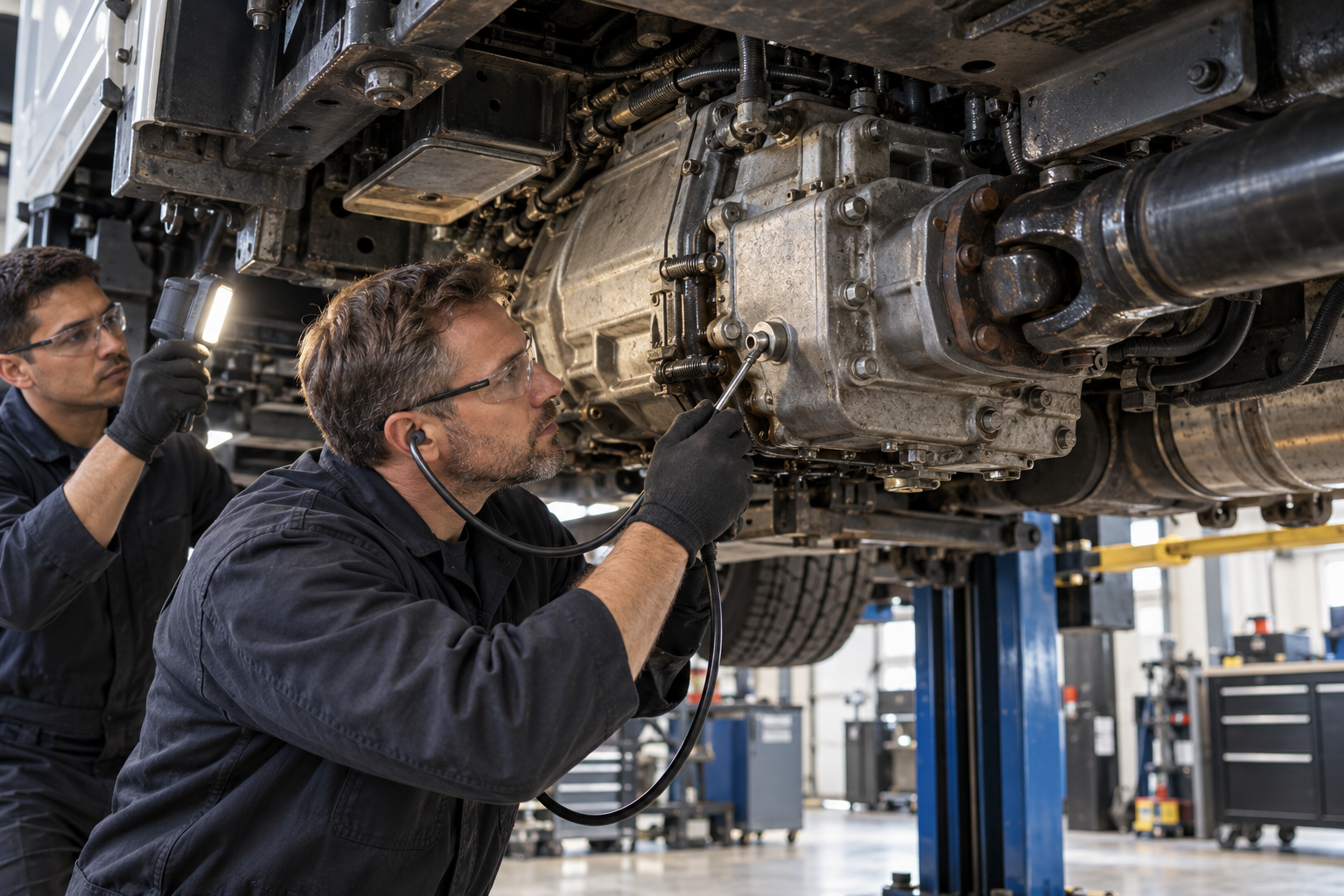
I first establish whether the sound existed before the PTO installation, occurs with the PTO disengaged, changes with engine rpm, changes under auxiliary load or disappears when the driven component is safely disconnected. Gear whine can be associated with a mesh that is too tight, while chatter can be associated with excessive clearance, but pump cavitation, torsional vibration, an out of phase shaft, loose hoses or contact with a frame member can imitate PTO noise. A baseline recording and a written condition matrix make the diagnosis more reliable than memory after the vehicle returns to the workshop. Only after these facts agree do I use couplings models and split shaft power take-off models to locate relevant candidate families, because no catalog page can replace the transmission identity, calculated operating point or installation drawing. In this process, Özcihan Makina is considered as a system partner rather than as a box selected only by bolt pattern. 🧭

Selection Criteria at a Glance 📊
A comparison table turns a crowded technical conversation into a shared checklist, and that simple step often exposes a missing value before it becomes a costly physical mismatch. 🔍 The table also helps us decide whether the catalog area represented by piston pump models belongs in the actual build, because mechanical capacity, hydraulic demand, controls and installation reality must be reviewed on the same page.
| Criterion | What I verify | What can happen if it is ignored |
|---|---|---|
| Whine rising with speed | Measured backlash, gasket stack and gear condition | A tight mesh can overload bearings |
| Chatter at low speed | Clearance, tooth wear and torsional input | Impact loading can damage the mesh |
| Noise only under load | Pump inlet, pressure, shaft alignment and capacity | The source may be outside the PTO |
| Intermittent knock | Loose mounts, contact points and damaged joints | Movement can progress to fracture |
| New sound with heat | Oil level, viscosity, bearings and temperature | Lubrication or wear may be deteriorating |

Reading the Tradeoffs Instead of Chasing One Number ⚖️
Removing or adding a gasket may alter backlash on designs that use shims, but doing so by ear is not a controlled repair and some transmissions use a predetermined arrangement that should not be adjusted that way. A slight gear sound can be normal in a particular architecture, especially when engine torsional vibration is transmitted through a live drive gear, yet a change from the documented baseline deserves investigation. I prefer evidence that narrows the source to a quick assumption that merely moves the noise. I use references such as what is a pto? and cardan shafts models to identify candidate technologies, and I apply the same discipline to splitter gearboxes models and truck pto models, but every final part must still earn its place through the exact data sheet, measured requirements and interface checks. A thoughtful selection by Özcihan Makina therefore considers the weakest interface and preserves a realistic margin without using unnecessary oversizing as a substitute for missing data. 🛠️💡

Engineering Support and Location 📍
A Practical Example 🧮
Imagine a unit that chatters at 700 engine rpm, becomes quieter at 1,000 rpm and grows louder again when the hydraulic pump reaches pressure. A technician might immediately remove a gasket, but a better sequence measures backlash, checks oil, inspects tooth contact, then runs a controlled unloaded test and evaluates the pump suction path. If the noise disappears when the remote driven line is safely isolated, the investigation moves toward shaft phasing, alignment or pump cavitation rather than changing an already correct PTO mesh. I like this example because every input can be challenged and verified, while efficiency, pressure loss, transient load and temperature remain visible instead of disappearing behind a headline rating. For the broader system check, I also consult transfer case models and valves models when those resources relate to the build, then verify the relevant technical documents because a correct PTO can still suffer beside a poorly selected or supported component. 📐


Installation, Commissioning and Diagnostic Discipline 🧰
Metal particles, rapid temperature rise, oil leakage, a sound that suddenly worsens, delayed engagement or vibration visible in the pump and shaft require the vehicle to be removed from service until inspected. Rotating equipment must never be approached during operation, and a stethoscope or sensor should be used only under an approved procedure with guards and safe distance. After correction, I repeat the same condition matrix to prove the symptom changed for the expected reason. My commissioning record includes part numbers, approved lubricant, specified fastener torque, measured settings, unloaded and loaded speed, working pressure, temperature and vibration observations, and Özcihan Makina should receive the exact application details whenever a standard match is uncertain. Before inspection, the vehicle must be secured and stored energy isolated under the manufacturer procedure, because an indicator lamp or a brief successful movement is not proof that the whole power path is healthy. 🔒

What Reliable Sources Add to the Decision 📚
For this subject I cross checked Muncie Power PTO noise troubleshooting guide, which connects whine or chatter with mounting conditions while warning technicians to verify backlash with a dial indicator instead of diagnosing by sound alone, Muncie Power transmission mounted PTO installation guide, which covers mounting face inspection, gasket or shim control, backlash measurement, approved lubricant and post installation leak checks and Dana Spicer driveshaft resource library, which offers application and service guidance for driveshaft operating parameters, lubrication and component selection. These references support a disciplined method, yet they do not replace the exact vehicle identity, current drawing, approved manual or applicable safety rules, which is an important EEAT distinction between education and application approval. The dedicated troubleshooting guidance gives a typical backlash range for many of its own units but also identifies exceptions and other noise sources, which is precisely why the applicable model manual and measurement method must control the repair. I record final assumptions and retest the completed system under representative load, since traceable evidence is the quiet backbone of trustworthy mobile engineering. 🌍✅

A Clear Recommendation for Long Service Life 🚚
The best noise diagnosis follows the sound without being seduced by it, separating gear mesh, driven equipment, structure and lubrication until one measured cause remains. Good engineering rarely announces itself with drama; it appears as predictable engagement, stable temperature, controlled sound, clean oil and a truck that completes its work shift without asking the operator to compensate for a design error. I recommend giving Özcihan Makina the full transmission designation, operating speed, rotation, peak and continuous demand, duty cycle, mounting drawing and environment, then confirming the proposal against the driven equipment limits before installation; that careful process is much faster than diagnosing burnt oil, fractured shafts, damaged gears or a pump that never reaches its target. 🤝⚙️
-212781031195243.png)