


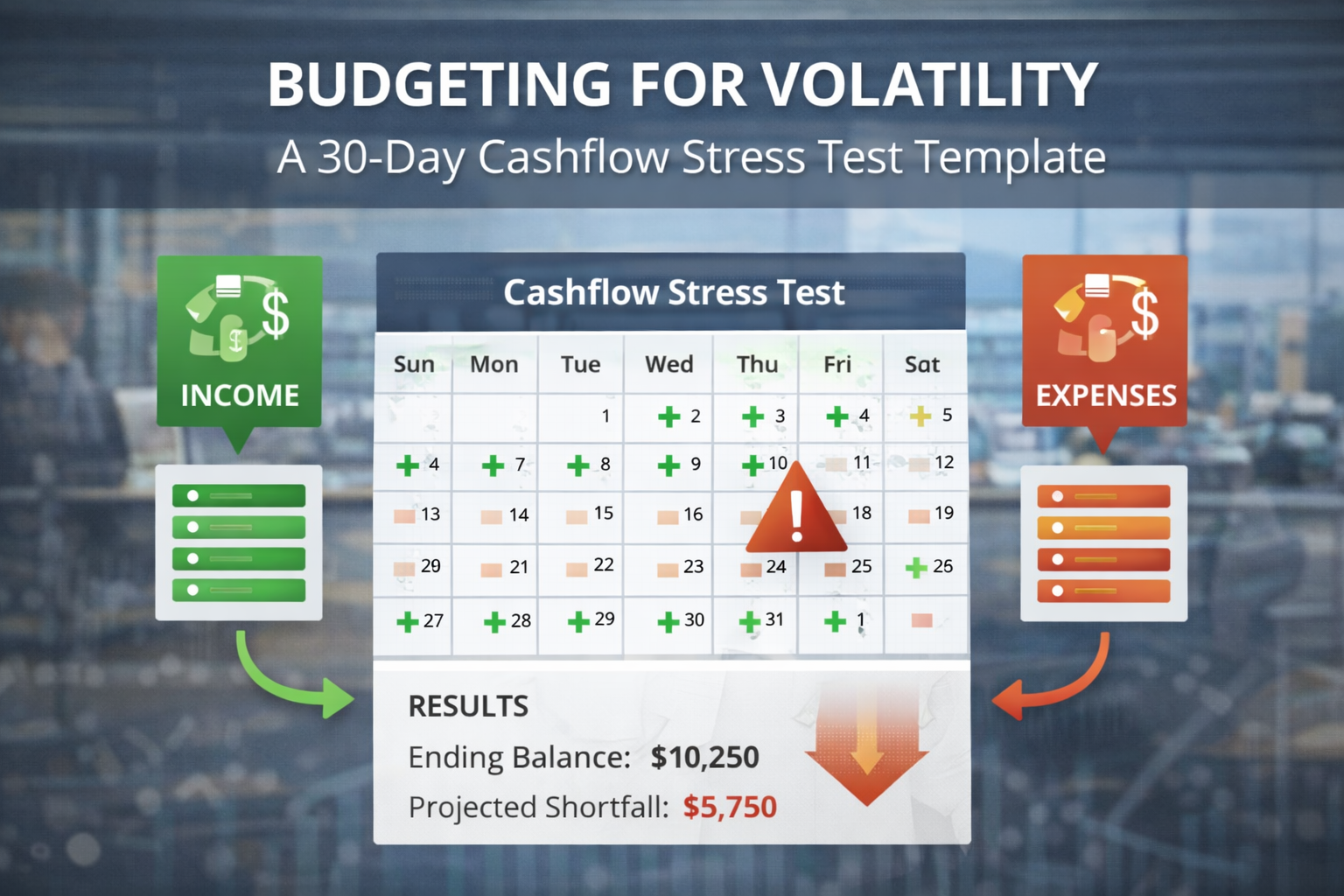
If you have ever looked at a healthy monthly profit and still felt that quiet panic of “why does the bank balance feel… thin?” 😅, you already understand the central truth that volatility teaches businesses the hard way: profit is a story about performance, but cash is a story about timing, and when timing becomes unpredictable, your budget needs a stress test that is fast, practical, and honest, which is exactly why a thirty day cashflow stress test is so powerful, because it forces you to look at the next few weeks with the same seriousness that banks use when they model short term liquidity risk, including the well known thirty day stress horizon in financial regulation and liquidity frameworks (you can see the formal use of a thirty calendar day stress horizon and net cash outflows logic in the OSFI Liquidity Adequacy Requirements guideline here: OSFI LAR Guideline 2025, and the Basel Committee’s Liquidity Coverage Ratio concept here: Basel III LCR) 🙂.
What you get in this post 🙂: clear definitions, why the thirty day window matters, a step by step way to run the stress test without turning it into a finance PhD project, a copy friendly template you can paste into a browser and fill in, an example scenario that makes the logic concrete, a short anecdote that mirrors how cash surprises actually happen, an emotional grounding because payroll stress is real, and a diagram you can screenshot so your team can run this every month like a calm routine rather than a last minute scramble. ✅
1) Definitions: What a “30 Day Cashflow Stress Test” Actually Is 🧩🙂
A cashflow forecast is a time based projection of cash inflows and outflows, usually organized by day or week, that starts with your opening cash balance and ends with a closing cash balance, and if you are starting from scratch, it helps to remember that governments and business finance institutions treat cash forecasting as a basic management tool rather than a luxury, which is why there are practical templates and guides that focus on expected earnings and costs, such as the UK government signposting to downloadable cash flow forecast templates and planning resources (see: UK Government business plan guidance) and the Start Up Loans cash flow forecast template page that explains why a cash forecast is important (see: Start Up Loans cash flow forecast template) 🙂.
A stress test is the part where you stop assuming the plan goes nicely and you model “what if” conditions, meaning you change key drivers like collections speed, sales volume, refund rates, supplier terms, payroll timing, or unexpected one off expenses, and you measure what happens to the cash balance, because the point is not to predict a single future, it is to find fragility, specifically the day your cash balance dips below your minimum safe level and forces a bad choice like missing payroll, delaying a supplier, or begging for emergency credit at the worst possible time 🙂.
The thirty day window matters because it is long enough to capture the typical “oops” moments that break a month, like a late customer payment, a tax due date, a rent withdrawal, a payroll run, a debt payment, or a supplier prepayment, and it is short enough that you can refresh it quickly with real data, and it has an important psychological benefit too, because teams can hold thirty days in their heads and act on it, while a twelve month forecast can become so abstract that nobody changes behavior until it is too late; this is the same practical reasoning behind why financial regulators and liquidity frameworks emphasize a short stress horizon with net cash outflows logic for the next thirty calendar days, because that horizon forces decision readiness instead of vague optimism (see: OSFI LAR Guideline and broader liquidity stress testing discussion from BIS here: BIS liquidity stress tests range of practices) 🙂.
A gentle but honest emotional truth 🫶🙂: most founders and operators do not fear “a bad month” in the abstract, they fear the moment they have to look a teammate in the eye and say payroll is delayed, and a thirty day cashflow stress test is basically your way of giving yourself the dignity of options before you are forced into panic decisions.
2) Why It’s Important: Volatility Punishes Timing, Not Intent 🧠💸
Volatility is brutal because it turns small timing changes into big consequences, meaning a customer paying ten days late is not only “ten days,” it is ten days that can overlap with payroll, taxes, and rent, and suddenly a business that is fundamentally viable feels like it is drowning, which is why the most useful mindset shift is to stop treating cash forecasting as a finance department artifact and start treating it as an operating rhythm, and if you want a practical framing that many small business institutions use, cash forecasting is about anticipating highs and lows and staying on top of finances, not about pretending you can predict the future perfectly, which is echoed in practical guidance like the British Business Bank’s article on creating a cash flow forecast and why it matters as part of business planning (see: British Business Bank guide) 🙂.
There is also a strategic reason this matters in volatile periods: when you know your short term cash position, you negotiate better, because you can choose whether to offer early payment discounts, whether to push harder on collections, whether to ask suppliers for a longer term, or whether to pause discretionary spend, and those are not “desperate moves,” they are professional liquidity management moves that keep the business in control, and control is exactly what volatility tries to steal from you 🙂.
Here’s the metaphor that helps teams remember why this is worth doing without turning it into drama 🙂: think of cash like oxygen in a high altitude climb, because you can have the best route plan and the strongest legs, but if oxygen gets thin at the wrong moment, you do not get to argue with the mountain, you adjust immediately, and in business terms the adjustment is a set of pre planned actions that you only get to choose calmly if you see the cash dip coming early enough.
3) How to Apply It: Run the Stress Test in a Calm, Repeatable Way ✅🙂
The easiest way to run a thirty day cashflow stress test without drowning in complexity is to treat it as a short weekly ritual where you refresh actuals, update the next four weeks, then apply a few standardized shocks, and you can borrow a page from how structured programs work in other settings: first you define what counts as cash inflow and outflow, then you project, then you apply a scenario, then you measure your buffer, and then you document actions, which is exactly the practical logic you will find in many free forecast templates and guides designed for everyday businesses rather than large banks, such as the UK cash flow forecast template in spreadsheet form that helps structure opening cash and month entries (see: UK cash flow forecast template file) and broader collections of forecast templates like Smartsheet’s overview for different use cases (see: Smartsheet cash flow forecast templates) 🙂.
Before you touch the template, do a quick “personal experience prompt” that sounds simple but changes everything 🙂: think back to the last time cash surprised you, then write down what the surprise actually was in plain language, like “two customers paid late,” “refunds spiked,” “we forgot a quarterly tax,” “a supplier demanded prepayment,” “a marketing bill hit earlier than expected,” because that memory is your best clue about what to stress test first, and it also creates an emotional connection to the process, because once your team has lived one cash surprise, they rarely want to live it again 😅.
Now, here are the core steps, written in a way you can run in one working session: start with your opening cash from your bank, list your inflows by expected receipt date rather than invoice date, list your outflows by actual payment date rather than expense recognition date, then calculate daily closing cash, then define a minimum cash buffer you refuse to cross, often expressed as a number of days of fixed costs or a payroll safety threshold, and then apply three stress scenarios that match reality for your business, such as slower collections, revenue dip, or expense spike, and the goal is to identify the exact day the buffer breaks, because once you know the day, you can choose actions like accelerating collections, negotiating terms, pausing non essential spend, or drawing a credit line early rather than late 🙂.
Scenario Settings Table: The Three Stress Knobs You Should Always Turn 🎛️🙂
To keep the stress test realistic, do not invent twenty scenarios, instead standardize a few that match how your business actually breaks under pressure, and if you want a simple structure, use baseline plus a mild shock plus a severe shock, because that mirrors how institutional stress testing frameworks often use baseline and stress scenarios across defined horizons (you can see the concept of baseline and stress scenarios in broader liquidity stress testing frameworks, even outside small business contexts, such as the NAIC liquidity stress test framework document here: NAIC LST framework) 🙂.
| Scenario | Collections change | Revenue change | Cost change | What you are testing emotionally 😅 |
|---|---|---|---|---|
| Baseline 🙂 | Normal payment timing | Expected sales | Expected spend | Can we operate calmly if nothing weird happens? |
| Mild shock 😬 | Top customers pay later | Small dip in orders | Small spike in refunds or shipping | Do we have a buffer for normal volatility? |
| Severe shock 🚨 | Big delay in receivables | Noticeable revenue drop | One unexpected bill plus higher costs | Will we cross the payroll danger line? |
4) Examples: A Realistic Walkthrough with a Concrete Template 🧾🙂
Let’s make this feel real with an example that mirrors what many SMEs live through: imagine a services business with weekly payroll, two large customers who pay on thirty day terms but sometimes drift, a monthly software stack, rent, and a tax payment due during the next month, and the business is profitable on paper, but the cash gets thin when collections slip, so you run a thirty day stress test and discover that under the mild shock scenario, you dip below your minimum buffer on day seventeen, which is exactly the kind of insight that changes behavior immediately, because it turns “we should watch cash” into “we need to collect faster before day seventeen or delay a discretionary expense before day fourteen,” and the emotional relief that comes from seeing the pinch point early is huge, because you stop guessing and start choosing 🙂.
Here is a short anecdote that feels familiar to many teams, told as a composite scenario rather than a dramatic single incident 🙂: a founder once assumed the month was fine because invoices were issued, then a key client asked for “just one more week,” a supplier charged earlier than expected, payroll landed on the same Friday as a tax payment, and suddenly the team spent an entire weekend negotiating payments and apologizing, and the real damage was not only the bank balance, it was the exhaustion and the loss of confidence, because you cannot do good work when your brain is stuck in emergency mode, and that is why this template is not only a finance tool, it is a mental health tool for operators who want the business to feel steady again 🫶🙂.
Quick reminder before the template 🙂: when you fill this in, use cash dates, not accounting dates, so you record when money hits the bank and when it leaves, and if you want a simple habit to build, refresh this weekly and keep the next thirty days always visible, which aligns with the practical approach described in cash forecast guidance like the British Business Bank’s step approach and template driven forecasting resources (see: British Business Bank and the template resources linked by the UK government here: UK Gov guidance). ✅
The 30 Day Cashflow Stress Test Template (Editable Cells) 🧾✍️🙂
Tip 🙂: you can copy this table into a web page or a note app that supports HTML, then click into the cells and type, and if you prefer spreadsheets, use this as the structure and move it into Excel or Google Sheets, or start with a downloadable template such as the UK cash flow forecast spreadsheet file here: cash flow forecast template.
| Day | Opening cash | Customer collections | Other inflows | Payroll | Suppliers | Rent and utilities | Taxes | Debt service | Other outflows | Net cash | Closing cash | Minimum buffer | Notes and triggers |
|---|---|---|---|---|---|---|---|---|---|---|---|---|---|
| 1 | |||||||||||||
| 2 | |||||||||||||
| 3 | |||||||||||||
| 4 | |||||||||||||
| 5 | |||||||||||||
| 6 | |||||||||||||
| 7 | |||||||||||||
| 8 | |||||||||||||
| 9 | |||||||||||||
| 10 | |||||||||||||
| 11 | |||||||||||||
| 12 | |||||||||||||
| 13 | |||||||||||||
| 14 | |||||||||||||
| 15 | |||||||||||||
| 16 | |||||||||||||
| 17 | |||||||||||||
| 18 | |||||||||||||
| 19 | |||||||||||||
| 20 | |||||||||||||
| 21 | |||||||||||||
| 22 | |||||||||||||
| 23 | |||||||||||||
| 24 | |||||||||||||
| 25 | |||||||||||||
| 26 | |||||||||||||
| 27 | |||||||||||||
| 28 | |||||||||||||
| 29 | |||||||||||||
| 30 |
When you run this template under stress scenarios, you will often discover that your biggest risk is not “sales drop” in general, it is a specific mismatch between cash in and cash out on a specific date, and once you see that mismatch you can design simple rules, like “if projected closing cash drops within twenty percent of the minimum buffer, collections outreach triggers immediately,” or “if severe scenario dips below buffer, discretionary spend pauses and supplier term discussions begin,” and these rules feel strict until you realize they prevent the much harsher rule that volatility will impose if you do nothing, which is “make painful decisions under pressure” 😅.
5) Conclusion: A Stress Test Is Not Pessimism, It Is Professional Calm ✅🙂
The main reason this thirty day cashflow stress test works is that it is short enough to be real, specific enough to produce actions, and emotionally grounding enough that teams actually use it, because it turns cash management from a vague fear into a measurable plan, and when you combine that with a simple baseline plus stress scenario habit, you end up with something every business wants in volatile times: options, and options are what create calm; if you want to deepen your forecasting practice over time, you can also borrow ideas from treasury and cash forecasting template guidance that emphasizes structuring categories, time horizon, and reporting dimensions, like the GTreasury cash forecasting template discussion here: GTreasury cash flow forecasting template, but do not wait for perfection, because the best stress test is the one you run consistently 🙂.
One line takeaway 🙂➡️: “Run the thirty day cash stress test weekly, watch the buffer break date, and act early so your decisions stay calm rather than forced.”
FAQ: 10 Niche Questions About a 30 Day Cashflow Stress Test 🤔🙂
3) Where do taxes belong in the template? Put them on the actual payment date, not the period they relate to, because the stress test is about bank balance timing rather than accounting recognition.
4) How do I model late payments without guessing wildly? Use your own historical behavior by customer group, and in the stress scenario add a simple delay for top accounts, because one delayed large receivable often matters more than ten small ones.
5) Should I include inventory purchases as suppliers or other outflows? Include them under suppliers if inventory is your business heartbeat, because keeping it visible helps you see how purchasing decisions collide with payroll and rent timing.
6) What is the most common “hidden” outflow people forget? Annual renewals, quarterly tax payments, insurance premiums, and software subscriptions, because they feel small until they stack on the same week.
7) How do I stress test a business that is seasonal? Keep the thirty day view but refresh the assumptions weekly, and add a scenario where a seasonal peak arrives later than expected, because timing shifts are the real risk.
8) Should I include a credit line draw as an inflow? Yes, but only if it is truly available and you are confident about covenant and access, and you should model it as a controlled action with a trigger rather than a free default rescue.
9) How often should we rerun scenarios? Weekly is a strong cadence for volatile periods, and at minimum after any major change, like a big customer delay, a supplier term change, or an unexpected expense.
10) What is a good first improvement after running this once? Tighten collections timing assumptions and add a simple trigger system in your notes column, because early action on cash in is often the fastest stabilizer.
People Also Asked: Practical Questions That Come Up in Real Finance Huddles 🔎🙂
What is the simplest set of cash categories that still works? Customer collections, payroll, suppliers, rent and utilities, taxes, debt service, and a catch all other, because simplicity supports consistency and consistency beats complexity in volatile times.
Should we run separate templates by business unit? If cash is pooled centrally, start with a single consolidated view, then add unit level detail only where it changes decisions, because the stress test exists to drive action, not to impress anyone.
What should we do if the severe scenario breaks the buffer no matter what? Treat that as a signal to secure liquidity early, renegotiate terms proactively, and reduce fixed commitments, because the goal of stress testing is to reveal fragility while you still have time to respond.
You should also read these…
- surgeblog.com – unable to update phone number on tiktok
- beofme.com – high ping in games causes and solutions
- spyfrogs.com – twitter x mobile app crashes device updates cache
- toojet.com – how to create a sustainable swap for everyday clot
- tugmen.com – the role of foam in modern packaging solutions
- toojet.com – opec holds the line reading oil policy signals for
- olddry.com – supply chains after a two year detour how to recal
- beofme.com – secrets of saving with pe foam
- hogwar.com – problems with turning tiktok notification sounds o
- sixrep.com – the power of gratitude for emotional well being